Starvard University · Tennis
A sport you can play your whole life. Learn the strokes, the scoring, and the simple strategies that make rallies fun from the first week.

The whole course in brief
Twelve lessons, one goal: rally, serve, and play real points.
The twelve lessons
Lesson 1
Tennis is one of the only sports you can play at full intensity at 25 and still play joyfully at 75. It scales: fast and fierce with a strong partner, gentle and social with a beginner. It is excellent exercise disguised as a game, working legs, core, and reflexes without feeling like a workout.
It is also a genuine social sport. Clubs, leagues, and ladders are built around meeting people at your level. Learn the basics once and you have a lifetime ticket to courts in every city on earth. Few investments of a few months pay dividends for fifty years.
Lesson 2
Your first racket should be forgiving: an oversize head (105 square inches or more), light weight, and a grip size that lets your index finger fit between your fingertips and palm when you hold it. Do not buy a pro's racket; it will punish every mishit. A $50 to $100 beginner racket is perfect.
Court shoes matter more than beginners expect. Running shoes are built for forward motion; tennis is all lateral movement, and the wrong shoes roll ankles. Get actual court shoes. Balls: start with regular duty balls on hard courts, and replace them when they go bald and soft, because dead balls teach bad timing.
Lesson 3
The continental grip, like holding a hammer, is the all-purpose grip for serves, volleys, and overheads. The eastern forehand grip, with the base knuckle on the third bevel, is the classic beginner forehand grip. Learn both; switching grips between shots is a fundamental tennis skill.
The ready position: knees bent, weight on the balls of your feet, racket up in front, and feet constantly moving in small split-steps as the opponent hits. Watch beginners and you will see flat feet and late rackets. Most "I cannot get to the ball" problems are actually "I was not ready" problems. Bounce on your toes between every shot.
Lesson 4
The forehand is your money shot. Turn sideways as the ball comes, take the racket back with a smooth loop, step into the ball, and swing low to high, brushing up the back of the ball to create topspin. Finish with the racket over your opposite shoulder. The low-to-high path is what generates the spin that brings the ball down into the court.
Topspin is the beginner's superpower. It lets you swing hard without hitting long, because the spin dives the ball down. Practice hitting with big, safe clearance over the net, three to six feet, and let the spin do the work. Depth plus spin beats pace for the first year.
Lesson 5
The two-handed backhand is the beginner standard: it is stable, powerful, and easier to time. Turn sideways early, take the racket back with both hands, step in, and drive through the ball with your shoulders doing the work. The non-dominant hand is the engine; think of it as a left-handed forehand for righties.
The one-hander is beautiful and harder, requiring earlier preparation and more strength. Unless you are drawn to it, start with two hands. Either way, the key checkpoint is the same: sideways preparation before the ball bounces on your side. Late backhands are weak backhands.
Lesson 6
The serve is the only shot you fully control, and it starts with the toss. A consistent toss, released at full arm extension and placed slightly in front, fixes most serve problems before they start. Toss with a straight arm, like placing the ball on a high shelf, and do not chase bad tosses; catch them and redo.
The motion: trophy position with the racket dropped behind your back, then uncoil upward, hitting up and out through the ball with a continental grip. Beginners should start with a simple, reliable serve deep to the box rather than a fast one. A serve that lands 90 percent of the time beats a cannon that lands 40 percent. Pace comes later; placement and reliability win now.
Lesson 7
The volley is a block, not a swing. At the net, keep the racket up and in front, step toward the ball, and punch it with a short firm motion. The biggest beginner error is swinging at volleys like groundstrokes. Think catch, not hit. Keep the wrist firm and let the ball's pace do the work.
The overhead is the serve's cousin for balls lobbed over your head: turn sideways, point at the ball with your free hand, and hit it like a serve. Do not backpedal wildly; turn and take a few quick steps. And the golden rule of net play: the first volley should go deep, not for a winner. Earn the putaway.
Lesson 8
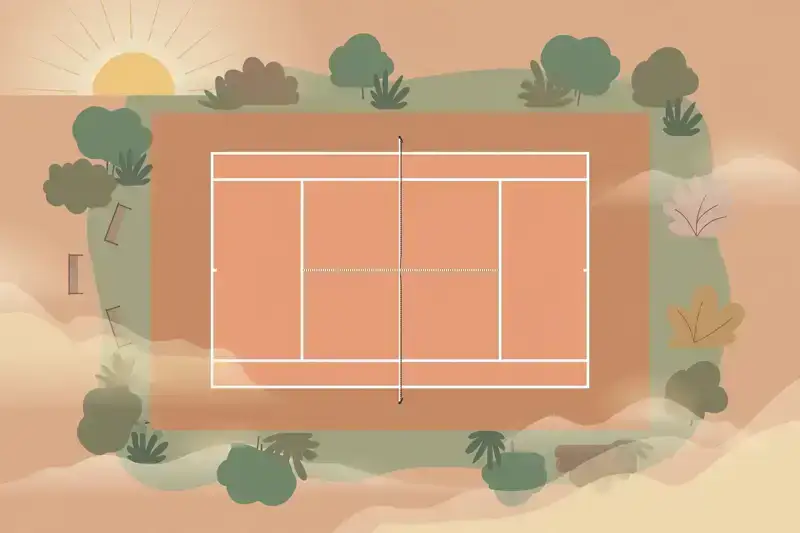
Points go 15, 30, 40, then game. Win four points and you win the game, but you must win by two. At 40-40, called deuce, you need two straight points: the first gives you advantage, the second wins the game. If you lose the advantage point, it is back to deuce.
Games stack into sets: first to six games wins the set, also by two, with a tiebreak at 6-6 in most formats. Matches are usually best of three sets. The server's score is always called first. It sounds baroque, but one watched set makes it click forever. The quirkiness is part of the charm.
Lesson 9
Beginner singles has one dominant tactic: hit deep and crosscourt. Crosscourt is the longest, safest path over the lowest part of the net, and depth pushes your opponent back. Most beginner points end in an error, so the player who keeps the ball deep and in play wins. Be that player.
When you get a short ball, that is your moment: move in and hit it firmly to the open court. Otherwise, patience. Do not change direction down the line unless the ball is begging for it, because the down-the-line shot is shorter, tighter, and riskier. Consistency is a strategy, and at the beginner level it is the best one.
Lesson 10
Doubles is the social fast track and tactically its own game. The server's partner starts at the net, and the returning team tries to keep both players back. The team that controls the net usually wins the point, because volleys end points fast.
Beginner doubles rules: serve and stay back until you are comfortable, return crosscourt and deep, and the net player should poach (cut across for the volley) when the return is weak. Communicate constantly: call "mine" and "yours", decide who takes the middle ball before the point. Doubles forgives weaker strokes and rewards teamwork, which is why it is the perfect beginner format.
Lesson 11
Tennis footwork is about small, quick adjustment steps, not sprinting. The split-step, a small hop as the opponent strikes the ball, loads your legs to explode in any direction. Then shuffle-step to the ball, set your feet, and hit balanced. Watch the pros: they take a dozen tiny steps where beginners take two big ones.
Fitness-wise, tennis is interval training: short bursts with rest between points. Build lateral quickness with side shuffles and short sprints, protect your shoulders with light rotator cuff work, and always warm up before playing hard. The players who last decades are the ones who treat warmups and stretching as part of the game.
Lesson 12
You do not need friends who play. Every city has a system: USTA leagues, club ladders, park district programs, and apps that match players by level. A ladder is perfect for beginners: you challenge players near your rung, and wins move you up. It guarantees competitive matches from week one.
Graduation
You know the strokes, the scoring, the core tactics, and where to find games. Tennis rewards the steady learner: every month of rallies makes the game more fun, and the game never stops giving back. This is a fifty-year sport. Enjoy all of it.
Keep learning
This course is part of Starvard University, striving for greatness.