Starvard University · Guitar 101
Three chords and the truth. Twelve lessons that take you from never holding a guitar to playing your first full song.

The whole course in brief
The twelve lessons
Lesson 1
You do not need an expensive guitar. You need a playable one: it stays in tune, the strings are not a mile off the fretboard, and the neck is straight. A $150 used acoustic that is set up well beats a $500 guitar with bad action. If you can, have a guitar-playing friend check it, or pay a shop $40 for a setup. It is the best money in guitar.
Acoustic or electric? Acoustic is simpler: no amp, no cables, pick it up and play. Electric is easier on the fingers: lighter strings, lower action. Either is fine. The best first guitar is the one you will actually pick up every day, so choose the one that excites you.
Get a tuner (free phone apps work), a few picks, and a capo eventually. That is the complete beginner kit. Everything else can wait until you know what you need.
Lesson 2
Standard tuning, low to high: E, A, D, G, B, E. Memorize it with "Eddie Ate Dynamite, Good Bye Eddie" or your own phrase. Tune every single time you pick up the guitar, no exceptions. An out-of-tune guitar teaches your ear wrong notes, and you will not notice because you are the one playing them.
Use a clip-on tuner or a phone app. Pluck one string, watch the needle, turn the tuning peg slowly toward the correct note. New strings stretch and go flat constantly for the first few days; this is normal. Stretch them gently by hand and retune until they settle.
Learn to hear when it is off, even roughly. Play a chord you know and listen: does it shimmer or wobble? Developing your ear starts here, with the humble act of tuning up.
Lesson 3
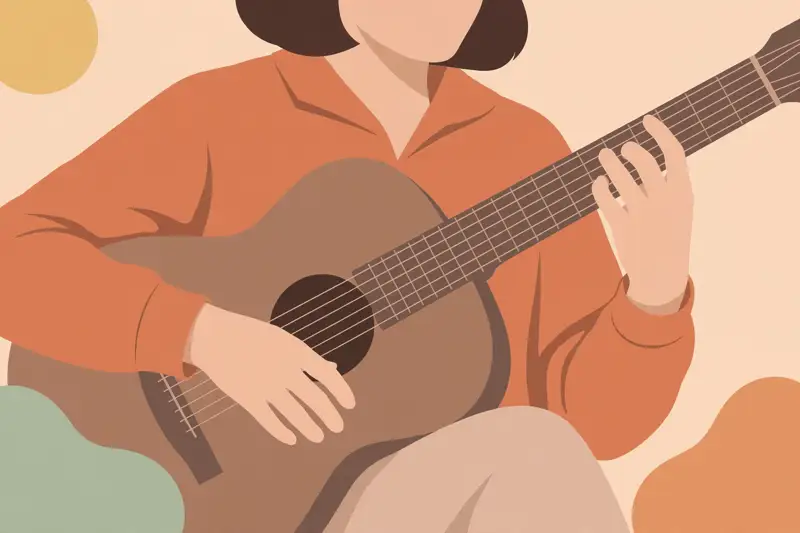
Sit up straight, guitar body resting on your dominant-side leg, neck angled slightly upward. The neck should not droop toward the floor; if it does, use a strap even while sitting. Your fretting hand thumb rests on the back of the neck, not wrapped over the top (yet).
Press strings with your fingertips, right behind the fret wire, not on top of it. Curl your fingers so they arc over the strings; flat fingers mute neighboring strings and that is where most beginner buzz comes from. Press just hard enough for a clean note. Beginners press twice as hard as needed, which causes pain and slow changes.
Lesson 4
G, C, and D. These three chords play hundreds of real songs, which is not motivational speaking, it is music theory: they are the main chords of the key of G, the friendliest key on guitar. Learn them one at a time, getting each one clean before adding the next.
For each chord: place your fingers, strum slowly string by string, and listen for dead or buzzing strings. Adjust finger position until every string rings. This fussy checking feels slow, but it builds the precise finger placement that makes everything later easy. Sloppy now means sloppy forever.
Your fingertips will hurt. This is normal, universal, and temporary. The skin toughens into calluses in about two weeks of daily playing. Short sessions, every day, build calluses fastest. Pushing through pain for an hour builds only resentment.
Lesson 5
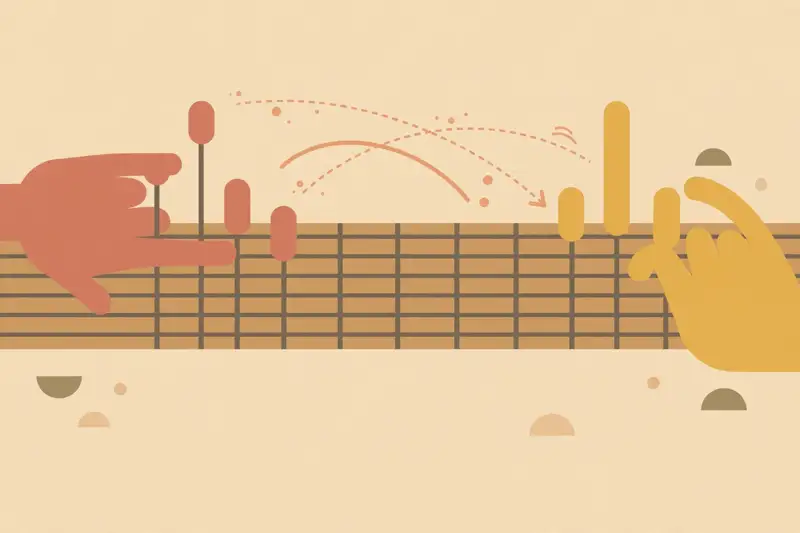
Knowing chords and playing music are different skills, and the bridge is the chord change. Beginners lift all fingers, hover, place them one by one, then strum. It takes five seconds and kills the rhythm. The goal is one smooth motion, and it comes from a specific practice method.
The method: pick two chords. Set a slow beat, one strum per bar. Change chords on the beat, no stopping, even if the chord is not perfect. Speed comes from keeping time while changing, not from perfect placement. Your fingers learn the shapes faster when the beat forces them to move.
Lesson 6
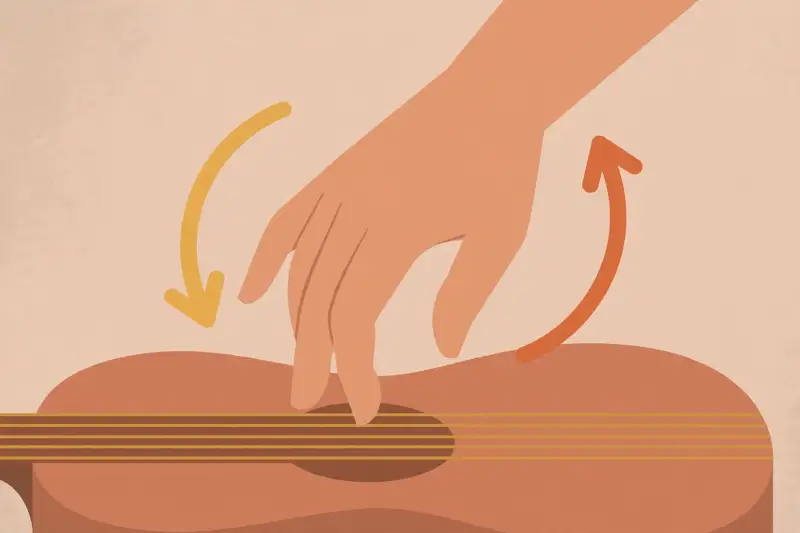
Strumming looks easy and feels impossible at first. The secret is the wrist, not the arm: loose, relaxed, brushing across the strings like you are shaking water off your hand. Tension is the enemy. If your shoulder hurts, you are arm-strumming; relax and let the wrist do it.
Start with all downstrokes on the beat: one, two, three, four. When that is steady, add upstrokes between: down, up, down, up. Keep the motion continuous, like a pendulum; the pick hits strings on the way down and on the way up. Missing the strings on purpose is part of patterns: the motion never stops, the contact varies.
Strum lightly. Beginners attack the strings; the guitar responds better to a relaxed brush. You can always play louder later. Control first, power later.
Lesson 7
Add Em, Am, D7, and Cadd9 (the pretty one). Em and Am are easy two-finger chords that unlock the key of A minor's worth of songs. These seven chords together cover an enormous percentage of popular music. You are now functionally a guitarist.
Learn them in pairs with songs attached. Em to Am is the sound of a thousand folk songs. G to Cadd9 to D is instant campfire magic. Chords learned inside real songs stick; chords learned as diagrams fade.
Start noticing chord progressions in music you love. You will hear G-C-D everywhere now, like buying a red car and seeing red cars. This is your ear waking up, and it is one of the great pleasures of learning guitar.
Lesson 8
Same chords, different strumming pattern, completely different song. Rhythm is what makes people tap their feet, and a handful of patterns cover most music: the steady down-up, the "down, down-up, up-down-up" folk pattern, the syncopated pop pattern with its missing beats.
Learn patterns by ear from songs. Mute the strings with your fretting hand and strum along to the recording, copying the rhythm without worrying about chords. Once your right hand owns the pattern, add the chord changes back. Separating the hands while learning, then combining, is the fast track.
Lesson 9
Pick a three-chord song you love. Not the impressive one, the beloved one. Love carries you through the repetition that mastery requires. Learn its chord progression, get the changes smooth at slow speed, add your strumming pattern, and play it all the way through.
Playing all the way through is a distinct skill from playing sections. Do not stop for mistakes; the performance continues. This trains recovery, which is what separates players from practicers. A missed chord you play through beats a perfect chord you stop to fix.
When you can play it three times in a row without stopping, you have a song. Play it for someone. Their smile is the real graduation, and it will fuel the next ten songs.
Lesson 10
Guitar plus voice is the dream for most players, and it feels impossible at first because it is two rhythms at once. The trick: automate the guitar first. Get the strumming pattern so solid you can do it while thinking about something else. Only then add the voice.
Start by humming, not singing words. Hum the melody over your strumming. When the humming sits comfortably, add lyrics one line at a time. It will fall apart repeatedly; that is the process. Each attempt wires the independence a little deeper.
Your singing voice does not need to be good. It needs to be yours. Some of the most beloved singers in history are technically rough. Singing with your guitar is about expression, not perfection. The campfire does not judge.
Lesson 11
Fifteen focused minutes daily beats two hours on Saturday. Muscle memory builds through frequent repetition with sleep in between; your brain consolidates the movements overnight. Daily players improve visibly week to week. Weekend players stall.
Structure it: two minutes tuning and warm-up, five minutes on the hard thing (the chord change that fails, the pattern that stumbles), five minutes playing songs you know, three minutes of fun (noodle around, try something new). The hard thing goes in the middle when focus is highest.
Lesson 12
You can play songs. That was the goal, and you did it. What comes next is up to you: barre chords unlock every key, fingerpicking adds beauty, music theory explains the why, and playing with others multiplies the joy. But none of it is required. Plenty of happy guitarists play G, C, and D around campfires for fifty years.
If you continue, the path is: more songs (repertoire is skill), barre chords (the F chord is the famous gatekeeper; it yields in weeks, not days), and playing with other people as soon as possible. Jamming with others teaches timing and listening faster than any solo practice.
Record yourself today playing your first song, and save it. In a year, listen back. The progress will amaze you, and it will carry you through the next plateau. There will be plateaus. Play through them. The guitar rewards the persistent above all.
Graduation
You started never having held a guitar. Now you tune without thinking, your fingers find G, C, and D, your wrist strums steady, and you can play a song all the way through. That is not the beginning of learning guitar. That is playing guitar. Everything from here is more songs, more joy, same fifteen minutes a day.
Keep learning
This course is part of Starvard University, striving for greatness.