Starvard University · Acting
Good acting looks effortless and feels inevitable. This course teaches the craft underneath it: objectives, listening, rehearsal, auditions, and the difference between stage and camera. No mysticism, just work.

The whole course in brief
Twelve lessons in ten points. The rest is practice.
The twelve lessons
Lesson 1
The word "act" means to take action. This is the entire craft in one sentence. In every moment of a play or film, your character is trying to get something from someone: forgiveness, a confession, a kiss, the truth. The audience watches the trying, not the talking.
Beginners think acting is about showing feelings. It is not. Feelings are the exhaust of action, not the engine. When you genuinely try to convince someone of something, your face, voice, and body do the work on their own. The trying is visible. The pretending is not.
Try this right now. Pick a simple objective: get a friend to lend you their car. Say the words out loud, really trying. Notice what your body does without instruction. That aliveness is acting. Everything in this course is a system for producing that aliveness on demand.
Lesson 2
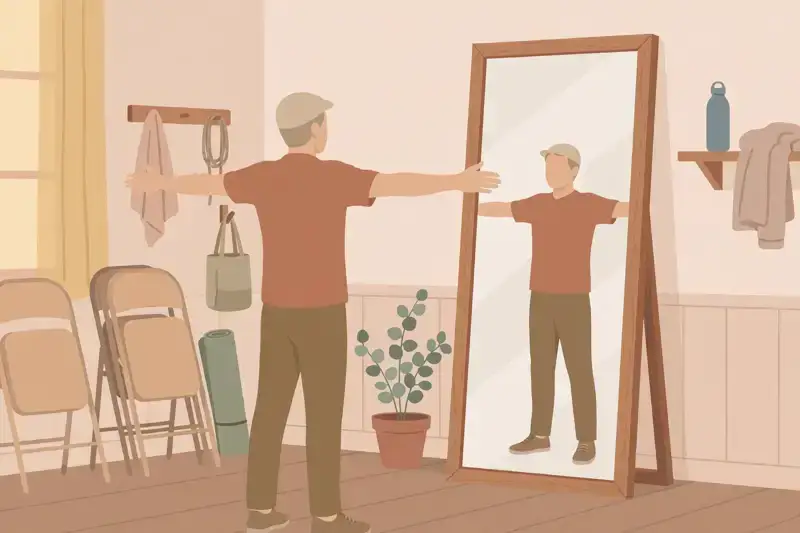
A violinist tunes the violin. An actor tunes the body. Tension is the enemy: locked shoulders, shallow breath, a jaw like a vise. All of it reads on stage and camera as stiffness. The daily work starts with releasing it. Shake it out, breathe low into the belly, let the jaw hang loose.
Your voice needs two things: breath support and clarity. Breath support means the sound rides on exhaled air from the diaphragm, not squeezed from the throat. Clarity means consonants land. Read a paragraph of a book out loud every morning, over-articulating every consonant. It feels ridiculous. It works.
Warm up before every rehearsal and audition, no exceptions. Ten minutes: stretch, breathe, vocalize, shake out. Professionals warm up. Amateurs skip it and wonder why the first scene felt rusty. Treat your body like the professional tool it is.
Lesson 3
Here is the fastest way to spot a bad actor: they are clearly waiting for their turn to talk. Their face goes blank while the other person speaks, then switches on for their line. Real people do not do this. Real people react while listening: they flinch, smile, get defensive, lean in.
Real listening means actually hearing the words for the first time, every time, even on the hundredth performance. Let your partner's line land and change you before you answer. That tiny beat of genuine response is what audiences read as truth. It cannot be faked, because it is not a trick. It is attention.
Practice with a partner reading anything: a phone book, a grocery list. Your only job is to truly listen and let it affect you. Then respond with the next line. You will be shocked how alive the most boring text feels when someone is really listening to it.
Lesson 4
Every scene, every character, every moment has an objective: what I want. "I want him to admit he lied." "I want her to stay." The objective must be active and aimed at the other person. "I want to be happy" is not an objective; nobody can act it. "I want you to say you need me" is.
Tactics are how you try to get it: charm, threaten, guilt-trip, seduce, reason, beg. When one tactic fails, you switch to another. That switching is the life of a scene. Mark your script with tactics like a map: line one, I flatter; line four, I challenge; line seven, I plead.
Objectives stack. The scene objective serves the act objective, which serves the play objective: the super-objective, the one thing your character wants through the whole story. Knowing the super-objective keeps every small choice pointed in the same direction.
Lesson 5
The performance is not where the work happens. The performance is the rehearsal with an audience. Rehearsal is where you make choices, test tactics, fail safely, and build the scene muscle by muscle. A great opening night is just a great rehearsal that got lucky with witnesses.
Rehearse in layers. First pass: just the words, getting them in your body. Second: objectives and tactics, what do I want and how do I try. Third: the relationship, the history between these two people. Only then polish. Polishing a scene with no foundation is painting a house with no walls.
Memorize lines by understanding, not by rote. If you know what your character wants in each beat and how they try to get it, the words follow the thought. Rote memorization produces recitation. Understanding produces speech. Learn the thoughts and the words come along.
Lesson 6
"Be sadder" is the worst direction in acting, and actors give it to themselves constantly. You cannot play sad. You can only play the attempt to get something, and sadness arrives as a side effect. The moment you try to manufacture a feeling, the audience sees the manufacturing, not the feeling.
This is why "crying on cue" is a parlor trick, not a skill. The actors who move us are not feeling harder; they are wanting harder. Want something badly enough from someone who will not give it, and the emotion shows up uninvited. The wanting is the craft. The feeling is the weather.
When a scene calls for big emotion, do not reach for it. Reach for the objective instead, and raise the stakes: what happens if I fail? Make the cost real and specific. The body knows what to do with real stakes. Your job is to give it something real to work with.
Lesson 7
A monologue is a scene with one person talking, but it is never a speech to nobody. There is always someone being spoken to, even if they never answer. Find that person. Are they in the room? Are you imagining them? What do you want from them? A monologue without a listener is a recital.
Pick monologues that fit you: your age, your energy, your truth. A twenty-year-old doing King Lear reads as costume, not character. Choose pieces where the want is urgent and specific. Two contrasting monologues (one comic, one dramatic), each under two minutes, is the standard audition package.
Break the monologue into beats, shifts where the tactic changes. Mark them. Rehearse each beat as its own small scene with its own objective. A monologue that never shifts is a flat line; one with three or four turns feels like a whole play in miniature.
Lesson 8
An audition is not a test. It is a performance for an audience of three tired people who want you to be good. They are rooting for you: every person who walks in could be the end of their long day. Walk in like a colleague, not a supplicant.
Make a strong choice and commit to it fully. A bold, specific, wrong choice beats a timid, vague, safe one every time. Casting directors cannot direct "maybe." They can redirect a clear choice in seconds. Decisive is directable. Careful is invisible.

Prepare the logistics like a professional: know your lines cold, arrive early, bring water, dress like a hint of the character without a costume. And let go of the outcome the moment you leave the room. You control the work. They control the casting. Confusing the two will eat you alive.
Lesson 9
Scenes are built between people. Your preparation is only half the job; the other half is your partner, and they will surprise you. The best moments in scene work are unplanned: a look that lands differently, a pause that stretches, a laugh that escapes. Leave room for them.
Do the homework together. Agree on the given circumstances: where are we, what just happened, what is our history? Then stop agreeing and start playing. Over-rehearsing a scene to a fixed pattern kills it. Rehearse the objectives and the relationship, and let each run be a little different.
When a scene goes wrong, the fix is almost always simpler than you think. Go back to the objective. Are you really trying to get something, or are you performing the idea of trying? Nine times out of ten, reconnecting to a genuine want fixes what an hour of note-taking cannot.
Lesson 10
Stage acting is big: you project voice and gesture to the back row. Camera acting is small: the lens sits inches from your face and catches everything. A thought flickering across your eyes fills a movie screen. On stage, that same thought needs your whole body.
The camera punishes pushing. Anything performed, indicated, or oversold looks false in close-up. The rule for camera: think the thought, want the want, and let the lens do the magnifying. Stillness is power on camera. The less you do, the more the audience sees.
Technical basics matter on camera: find your light, know your mark, keep continuity in your eyelines and movements between takes. And learn to do it the same way ten times. Film acting is the art of the repeatable spontaneous moment, take after take after take.
Lesson 11
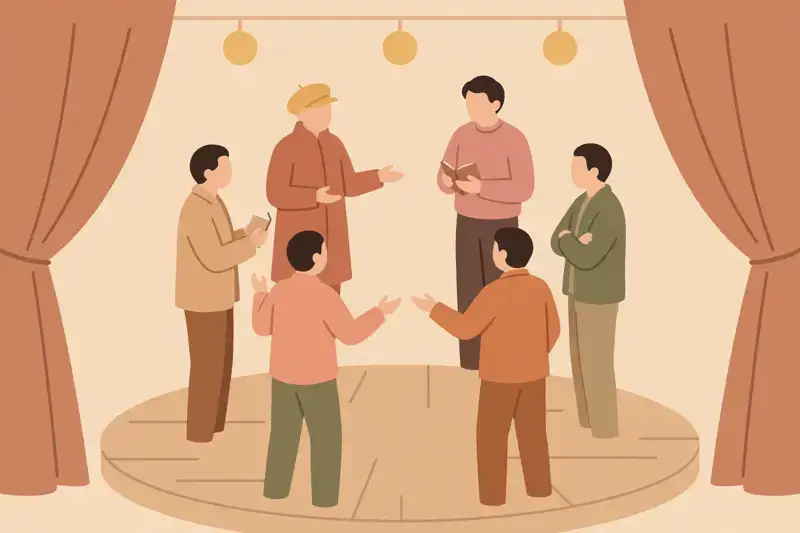
No great performance happens alone. The famous scenes you love are duets, not solos: two actors listening, pushing, surprising each other. Your job in an ensemble is to make your partner look good. Paradoxically, that is also how you look good.
Ensemble acting means knowing the whole play, not just your part. Read it all. Understand every character's journey. The best supporting actors are the ones who know exactly what the scene needs and supply it, even when the spotlight is elsewhere. Generosity reads as talent.
Offstage behavior is part of the craft. Be on time, know your lines, help with the load-in, do not gossip about the cast. Directors cast people they want in the room for six weeks. The actor everyone loves working with gets hired again. Reputation is a career strategy.
Lesson 12
Weeks 1-3: the instrument. Daily warm-ups, breath work, reading aloud. Weeks 4-6: objectives and tactics on short scenes, with a partner if you can find one, alone with a monologue if you cannot. Film yourself. Watching yourself is brutal and invaluable.
Weeks 7-9: two contrasting monologues, memorized, beaten out, performed for anyone who will watch. Weeks 10-11: scene work or an audition workshop, real rooms with real stakes. Week 12: perform something, anywhere: a class showcase, a community theater audition, a self-tape.
Then keep going. Acting is a practice, not a destination. Classes, community theater, student films, improv jams: the work is everywhere and most of it is free. The actors who last are not the most talented. They are the ones still practicing in year ten.
Graduation
You now know what working actors know: act the objective, listen for real, rehearse the work, and let the feelings arrive on their own. The craft is learnable, the practice is daily, and the stage is waiting. Break a leg.
Keep learning
This course is part of Starvard University, striving for greatness.